Three styles of closeness.
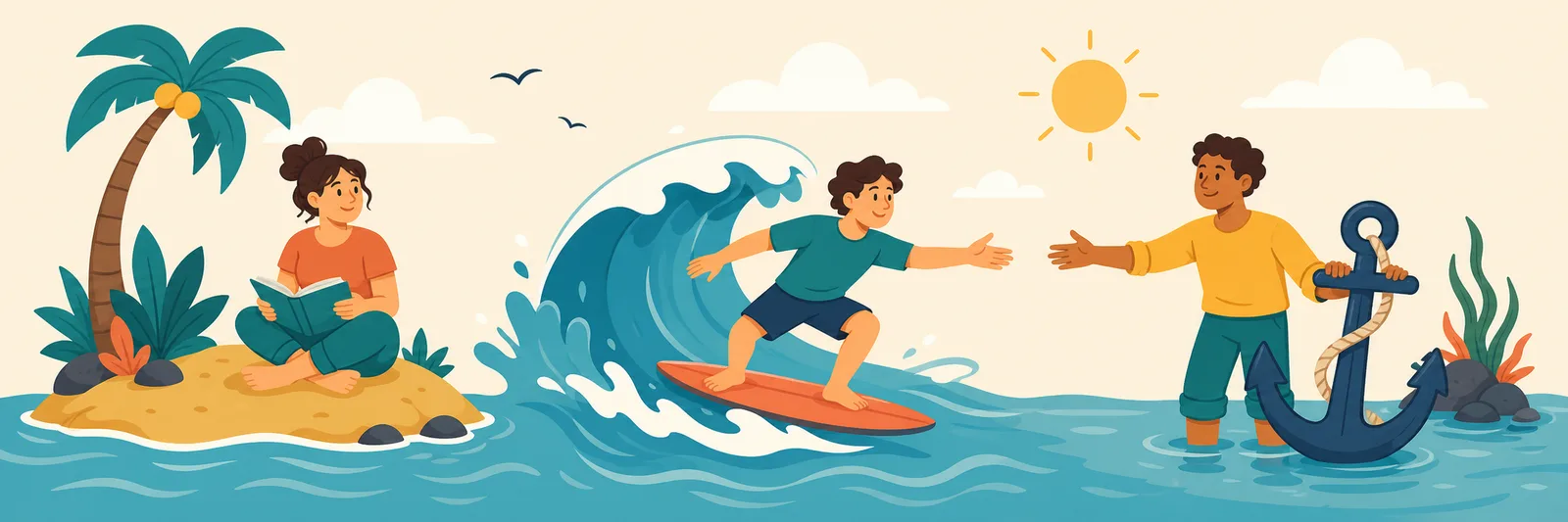
Tatkin describes three ways people handle closeness and names them island, wave and anchor. This lesson is about recognising them in yourself. Living with them in a partner comes next.
Attachment is a safety system
Lesson 1 ended on the need to be tethered to someone. Attachment is how that tie was first built. Tatkin describes early attachment as a child's safety and security system: how safe you felt with the few people who looked after you, whatever the house or the country was like.
He reduces it to signal and response. A child signals a need by crying, reaching or calling out, and what counts is what happens next. Does someone come reasonably soon? Is the response what the child needed? And can the child signal without being made to pay for it?
Repeated over and over, those answers set a pattern: how you move toward the people closest to you, how long you can stay near them, and when you need to get away. The pattern settles into the body and the automatic brain from lesson 1, which is why it turns up in adult love without being chosen.
Three portraits, exaggerated on purpose
Tatkin sorts these patterns into three groups: islands, waves and anchors. He draws each in its most extreme form, almost as a cartoon, so that you can tell whether you recognise yourself. Nobody fits one neatly. You may see yourself in two, or a little in all three.
Three warnings come with the portraits.
- All three are normal. They are ways a child adapted to the adults around them, not diagnoses. Anchor does not mean healthy.
- They are not weapons. The names are for understanding each other, not for hitting each other with.
- The aim is not to change type. He wants you to know how each of you is wired and to work with each other as you are.
At a glance
| Island | Wave | Anchor | |
|---|---|---|---|
| Childhood home | Performance and appearances came first. Little contact or repair. | Real closeness, from a caregiver who was often preoccupied. | Relating came first. Hurts were repaired quickly. |
| How you calm down | Alone: auto-regulation. | Through someone else, one way: external regulation. | Together, back and forth: interactive regulation. |
| Hardest switch | From alone to together. | From together to alone. | Neither is a strain. |
| Core fear | Engulfment: being intruded on or swallowed up. | Abandonment: being left or dropped. | No strong fear of either. |
| How you talk | Little about yourself. Filters first. | A lot. Thinks out loud and wanders. | Enough. Easy to follow. |
| Partings and reunions | Relief when the partner goes. Being called back jars. | Partings hurt. Reunions mix relief with anger. | Misses the partner and lights up on return. |
Island
Alone is where you rest
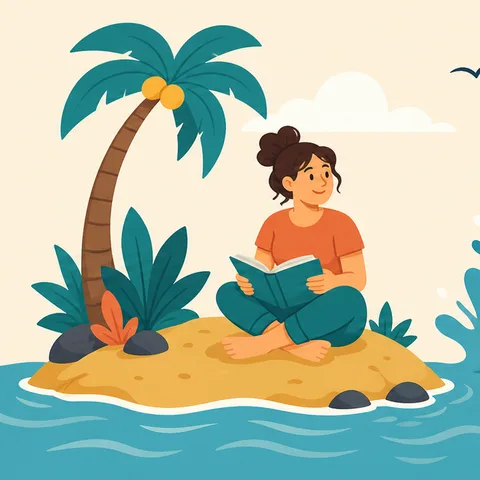
As an island you like people, and you like your own space more. Being with someone up close costs you energy, most of all with the people nearest to you. Tatkin calls this interpersonal stress. Your ideal partner is somewhere in the house but stays out of your room until asked in.
You settle yourself alone, with a book, a screen or a project. Everyone does that sometimes. Islands lean on it too much. Time alone is a kind of trance, so hearing your name called from another room feels like being shaken awake. Going from solitude to company is your hard direction.
The home that shaped you
Tatkin traces this to a home where relating did not come first. At least one parent cared most about performance, looks or what other people thought. There was little face-to-face play and little apology after a hurt, and you were often left to yourself.
You learned to guard the self more than the bond, and that needing things was shameful. So you became undemanding and careful about what you revealed. As an adult you say little about yourself, dislike owing anyone anything, and expect a partner to be just as self-reliant. His example is a couple who agree to give each other nothing at Christmas.
The need you hide
Tatkin does not accept this independence as true self-sufficiency. It grew out of going without, he says, whereas real autonomy grows out of having been able to depend on someone. He reports that island children look content playing alone while their stress hormones run high and their play is thinner than other children's. Adult islands, he adds, sleep, eat and work less well when the partner is away.
A few more tells. Asked who put you to bed as a child, you answer at once but cannot find an actual memory, and your picture of childhood tends to be rosier than it was. He considers islands the least able of the three to explain their own behaviour. And because you give so little away, your reserve can look like dishonesty when it is really caution.
Wave
Close, then suddenly not
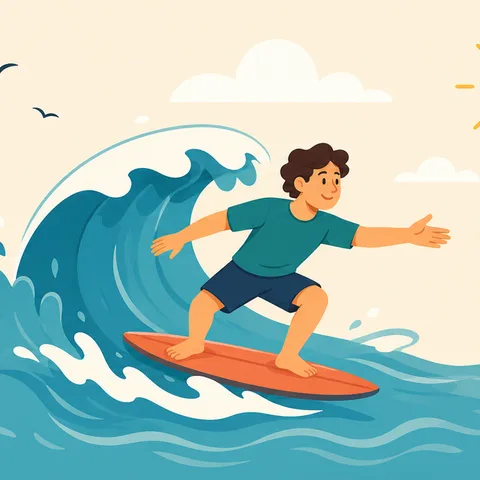
As a wave you had what the island missed: at least one parent who enjoyed holding you and being near you. But this parent was often taken up with their own worries, low mood or sense of being overwhelmed. Sometimes you were seen and sometimes looked past, and part of your job was to manage their feelings.
Tatkin's picture is a child on a diving board calling for a parent to watch. Some days the parent is watching and some days not.
Hard partings, angry reunions
People do not wear you out, and you would sooner be with someone than alone, so your hard switch is the reverse of the island's: from company to solitude. Partings sting. Reunions are mixed, because the relief arrives together with anger at having been left and the expectation that it will happen again.
Tatkin calls the result being allergic to hope. Hoping for something in love sets off the expectation of losing it, and that makes you angry in advance. So a compliment gets a dry remark, and you may find fault or threaten to leave. He is direct about it: a wave has to own the hostile things they do out of fear of going all in.
You settle through someone else
When you are upset you move toward your partner. You talk, ring again, leave long messages, because you cannot calm down without them. This is external regulation, and Tatkin stresses that it runs one way: you need to be soothed, and a real back-and-forth is hard for you in that state. You also think out loud, so your talk can run long while your partner grows more upset.
The habit has a generous side. You are good at looking after other people's feelings and tend to end up as the listener in any group. And he credits waves with one thing over islands: your worry is about the relationship, not only about yourself.
Anchor
At ease in both directions
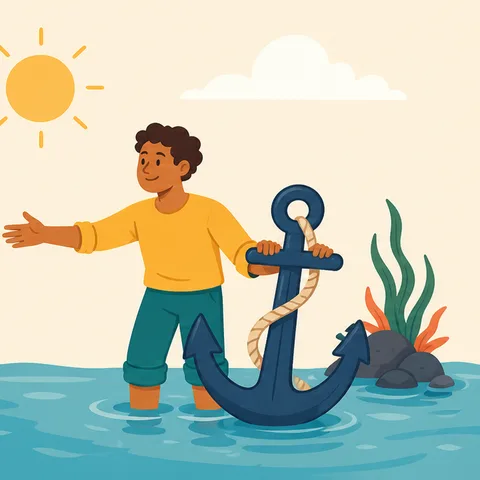
Most people wish they were anchors, Tatkin says, and he repeats that it does not mean healthier or better. As an anchor you are comfortable alone and comfortable in company, and moving between the two takes no effort. You say neither too much nor too little, keep no secrets, and are easy to follow.
You read faces well and can name what you feel yourself. Apart from your partner, you miss them and think well of them. When you meet again you are plainly glad, with what he calls a gleam in the eye. When something is wrong you want to sit down face to face and sort it out together, which is interactive regulation.
A home where relating came first
In an anchor's family, relationship came before performance or appearances. A hurt was mended quickly, with an apology. Your parents looked after each other, so you did not have to manage their moods and were free to be a child.
That is why you can depend on someone without shame and stand on your own without strain, and why you carry neither the island's fear of being engulfed nor the wave's fear of being left. Your working rule is what he calls true mutuality: whatever the two of you do has to work for both.
Lifelong style, current pull
Did none of the portraits quite fit? Then you are probably an anchor who leans a little toward island or wave. Tatkin mentions one study, unnamed and with the warning that studies are never fully reliable, in which a little over half of people in the West came out as anchors. Among the rest, he says, islands outnumber waves.
He treats a true style as lifelong. If you are an island, a wave or an anchor, you were one as a child too.
What does shift is the way a particular relationship pushes you. Pair an anchor with a very distant island and the anchor starts to pursue and cling, which looks like a wave. A mild island with a much stronger one can end up asking for more contact, although they do not want much closeness in general. They only need more than they are getting.
So ask two separate questions. Which description fitted you from childhood on? And which way does your current relationship push you?